In procurement and sourcing, it’s all too easy to become fixated on the lowest unit price. But as many UK businesses now recognise, securing value means looking far beyond the “£ per piece” cost. Enter the concept of Total Cost of Ownership (TCO) — a holistic view of all the costs associated with a product or material over its lifecycle. At Staspack Ltd, we help businesses reframe their sourcing decisions through a TCO lens, unlocking smarter choices, stronger margins and improved supply-chain performance.
Why unit cost alone is no longer enough
In today’s complex and rapidly evolving environment, simply picking the cheapest supplier is a risky strategy. Hidden costs lurk around every corner: transport delays, customs clearance, warehousing, quality issues, obsolescence, returns, inventory holding and sustainability compliance. According to industry research, businesses are increasingly shifting to a cost-to-serve mindset: assessing the cost of each supply-chain node, each customer channel and each route to market.
For UK SMEs and mid-market firms, this means missing the bigger picture can quickly erode margins. At Staspack Ltd we guide our clients to evaluate every cost layer — not just the immediate purchase cost.
What TCO really means in practice
Total Cost of Ownership covers a broad spectrum of factors, including:
- Purchase cost: The headline price from the supplier.
- Freight and logistics costs: International transport, inland haulage, customs duties, handling.
- Inventory holding costs: The cost of capital tied up, warehouse space, shrinkage.
- Quality and defect costs: Scrap, re-work, returns, warranty claims.
- Operational costs: Supplier management, inspections, supplier site visits.
- End-of-life or disposal costs: Especially important where sustainability or regulatory compliance is in play.
- Risk costs: Supplier disruption, geopolitical volatility, currency shifts, compliance failure.
When procurement decisions routinely incorporate these factors, clients achieve a truer view of value — and often find that the “cheapest” item is not the most cost-effective in the long run.
How Staspack Ltd supports TCO optimisation
At Staspack Ltd we take a structured approach to embedding TCO thinking into procurement:
- Baseline mapping and benchmarking – We start by assessing existing spend categories: what you pay, where you source from, how much you spend on logistics, how many returns or quality issues you face.
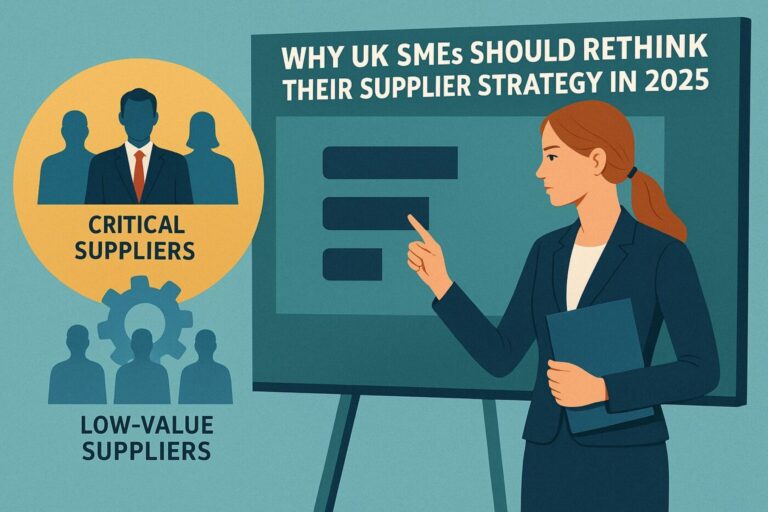
- Supplier segmentation and cost-to-serve modelling – Suppliers are analysed not just on price, but on lead-time, reliability, need for inspection, transport mode and location. This allows clients to differentiate which suppliers truly deliver value.
- Total cost modelling of sourcing alternatives – With transparent cost inputs, we compare sourcing options: for example, sourcing from a near-shored supplier with slightly higher unit cost but lower freight, shorter lead-times and fewer inventory holding costs versus a far-shore low-cost supplier.
- Change planning and implementation support – It’s one thing to identify a better TCO option; it’s another to operationalise it. We support supplier onboarding, contract structuring, logistics optimisation and risk mitigation to ensure the chosen model delivers.
- Performance tracking and continuous improvement – TCO is not static. We help clients monitor KPIs: defect rates, on-time delivery, freight cost per unit, inventory days, cost per order. These metrics feed into future sourcing decisions and drive continuous improvement.
Why this matters now for UK businesses
There are multiple pressures converging that make TCO optimisation mission-critical. With inflation biting, energy and transport costs elevated, labour markets tight and regulatory burdens growing, the levers for margin improvement are narrowing. The supply-chain environment remains volatile and unpredictability is the new normal. In this context:
- Shorter lead-times reduce inventory risk and free up working capital.
- Reliable suppliers reduce quality and re-work costs.
- Transparent logistics reduce surprises and hidden surcharges.
- Supplier partners who support innovation (material changes, efficiency improvements) become strategic assets, not simply vendors.
For smaller UK businesses in particular, embracing TCO thinking gives a competitive edge: it allows them to compete not just on price, but on smarter procurement and supply-chain design.
Real-world example: choosing smarter sourcing
Imagine a brand sourcing a plastic component for a consumer product. On first glance, Supplier A offers £1.70 per part from a low-cost region but has 10 weeks lead-time, high freight cost, occasional quality issues and higher inventory needs. Supplier B offers £1.95 per part from a nearby country, lead-time of 4 weeks, lower freight cost, strong quality record and fewer inventory days.
When analysed for TCO:
- Supplier A’s freight and inventory holding push the effective cost to ~£2.20 per part.
- Supplier B’s stronger logistics and quality give an effective cost of ~£2.05 per part.
Choosing Supplier B becomes the smarter decision despite the higher headline unit cost, because the TCO is lower and risk is reduced. Staspack Ltd guides businesses through exactly these trade-offs, ensuring that the sourcing decision aligns with operational and financial reality.
Embedding TCO culture in procurement
To make TCO optimisation sustainable, a shift in mindset is required:
- Procurement must collaborate closely with logistics, operations and finance functions.
- Supplier contracts should include metrics beyond price (e.g., defect rate, lead-time, responsiveness).
- Inventory strategies should move from “just-in-case” hoarding to “just-right” holding aligned to risk appetite.
- Supply-chain transparency is needed — data collection, supplier disclosure, logistics cost tracking all matter.
Staspack Ltd acts as the connective tissue: we bring together procurement, supply-chain, finance and supplier management under a coherent TCO framework, tailored for UK business scale and ambition.
Looking ahead: TCO and evolving business models
As business models evolve — subscription services, customisation, rapid product refresh cycles — TCO thinking becomes even more important. It’s no longer just about cost per unit sold but about cost per outcome delivered: rapid launch, high-quality experience, minimal waste, minimal regulatory risk.
Staspack Ltd is ready to support clients in this next wave. Whether you’re sourcing components, finished goods, semi-assemblies or aligning multiple supply-chain nodes, we help you map the full cost picture, make smarter decisions and build sourcing strategies that deliver margin, agility and resilience.
In summary
Unit cost will always matter, but if it’s the sole decision driver you’re missing the larger sourcing picture. Total Cost of Ownership represents the true economy of a sourcing decision — and for UK businesses seeking competitive edge, logic and operational strength, TCO is the lens you need. With Staspack Ltd’s expertise, you can shift from cost-chasing to value-creating sourcing, optimise across every cost dimension and build a procurement framework that supports growth, quality and future-readiness.
Ready to Elevate Your Brand?
📞 Call us: +44 (0)7890 823840
📧 Email: sales@staspack.com
📍 Address: 4 Ash Way, Didcot, OX11 6AN, United Kingdom
🌐 Visit: www.staspack.com
Follow us on social media for the latest updates on product sourcing trends, packaging innovations, and AI in procurement.